Insights From a Warehouse Manager With Over 20 Years of Experience
After more than twenty years managing warehouse operations—and spending much of that time helping design and deploy robotic systems—I’ve learned that automation decisions are rarely just about technology. They’re about whether your operation is under enough pressure that traditional methods no longer scale efficiently. Today, with e-commerce growth accelerating and customer expectations shaped by companies like Amazon, many operators are seriously evaluating autonomous mobile robots for e-commerce environments.
From my perspective on the floor, the question isn’t whether robots are the future. It’s whether they make financial and operational sense for your specific warehouse operation right now.
The New Reality of E-Commerce Warehouse Operations
Rising Complexity and Expectations
Two decades ago, most facilities were designed around predictable pallet or case shipments. Today’s e-commerce fulfillment is fundamentally different. Orders are smaller, SKU counts are higher, and customers expect delivery in one or two days—or faster. This shift has transformed the way warehouse operations function.
I remember managing a distribution center where our SKU count doubled within a year after we launched direct-to-consumer sales. Our team worked harder than ever, but productivity dropped because travel time increased dramatically. That experience was one of the first times I realized that simply hiring more workers wouldn’t solve structural inefficiencies.
Modern warehouses are now juggling multi-channel fulfillment, returns processing, and seasonal spikes simultaneously. That level of complexity creates the perfect environment for automation to add value.
Understanding Autonomous Mobile Robots in Practice
What They Actually Do on the Floor
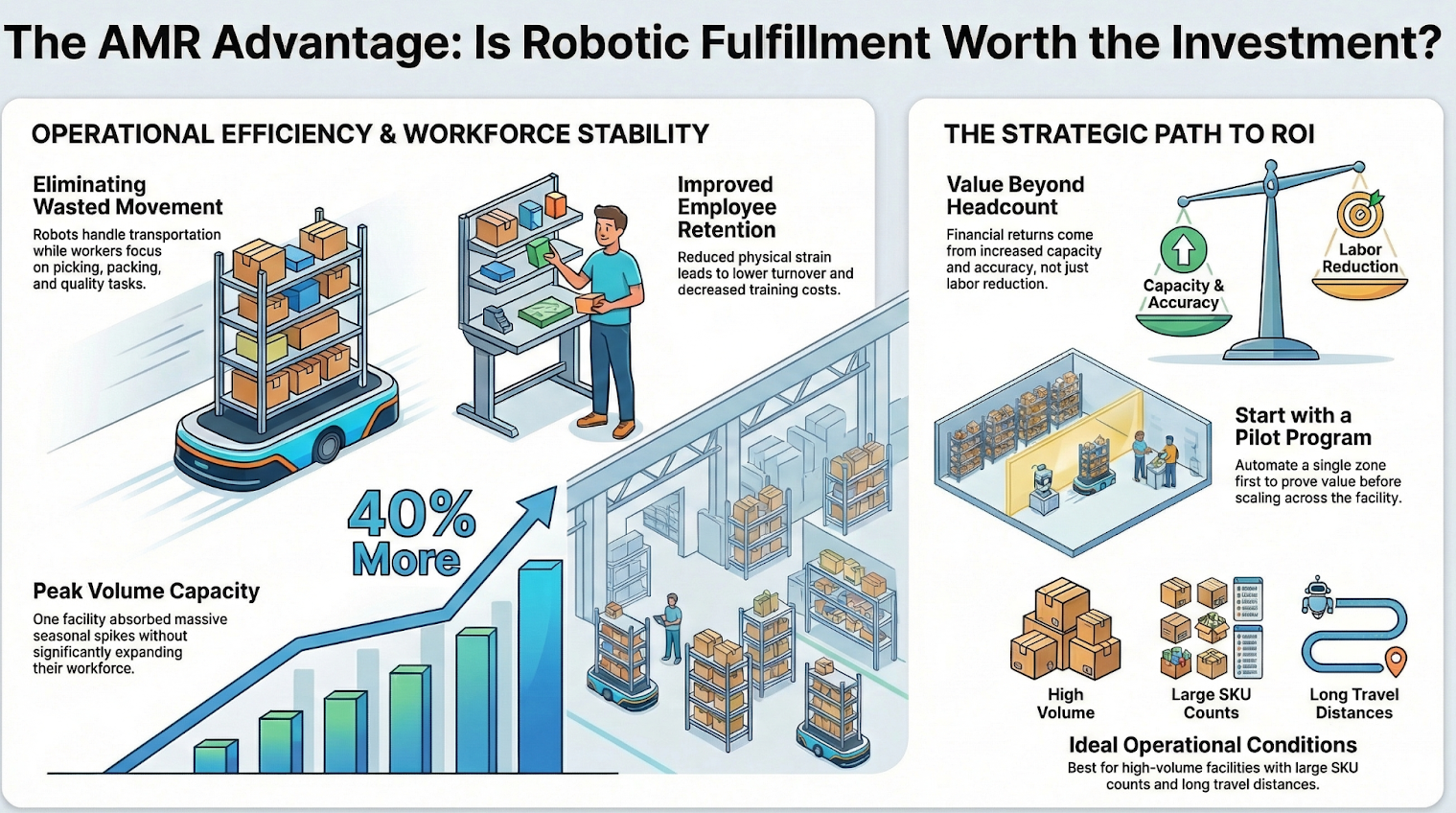
Autonomous Mobile Robots (AMRs) are designed to move materials efficiently throughout a warehouse without fixed paths or heavy infrastructure changes. Instead of workers walking miles each shift to retrieve products, robots handle transportation while employees focus on picking, packing, or quality tasks.
This distinction is critical. Robots don’t eliminate labor—they remove wasted movement. In most warehouse operations, walking consumes the majority of a worker’s time. Reducing that inefficiency can dramatically increase productivity without increasing physical strain.
In one implementation I oversaw, pickers stayed within designated zones while robots transported inventory between locations. Within weeks, we saw measurable gains in throughput and employee satisfaction.
The Financial Perspective: Investment vs Return
Looking Beyond Upfront Costs
One of the biggest misconceptions about automation is that the ROI comes from reducing headcount. In reality, the financial return often comes from increased capacity and efficiency rather than labor elimination.
Initial investments typically include hardware, software, integration, and infrastructure adjustments. For many operators, that price tag can feel intimidating. However, focusing solely on upfront cost misses the broader economic impact.
The real financial benefits often include increased picks per hour, reduced overtime, improved accuracy, and the ability to handle higher order volumes without proportional labor increases. In one facility I managed, automation allowed us to absorb nearly 40 percent more volume during peak season without expanding our workforce significantly. That alone justified the investment within a relatively short period.
Operational Benefits From a Manager’s Perspective
Productivity and Workforce Stability
One of the most underrated advantages of automation is its impact on employee retention. Warehouse jobs are physically demanding, and high turnover creates constant training costs and performance variability.
After deploying robots in a mid-sized e-commerce facility, walking distances dropped substantially. Employees reported less fatigue, and turnover decreased over the following months. Productivity gains followed naturally because experienced workers stayed longer and performed better.
From a management perspective, workforce stability is just as valuable as raw productivity improvements.
Accuracy and Customer Experience
Automation also improves consistency. Robots follow system instructions precisely, reducing variability between shifts and workers. When integrated properly with warehouse management systems, they guide employees through optimized workflows that minimize errors.
In one project, we saw mis-picks decline significantly within the first quarter after deployment. Fewer errors meant fewer returns, lower reverse logistics costs, and improved customer satisfaction—benefits that extended beyond the warehouse itself.
Scalability During Peak Periods
Peak seasons used to be the most stressful time of the year in every facility I managed. Hiring temporary labor, training quickly, and maintaining quality under pressure was always challenging.
Robotics changes that dynamic. Instead of scrambling for workers, you can scale throughput by adjusting robot fleets, extending hours, or optimizing workflows. That level of flexibility provides operational confidence that traditional systems simply cannot match.
Choosing the Right Technology Partner
Why Implementation Matters More Than Hardware
After years in automation projects, I’ve learned that the partner you choose often matters more than the technology itself. Successful deployments require deep understanding of workflows, integration challenges, and change management.
Companies like Aro Robotics focus specifically on warehousing solutions that integrate automation into real operational environments. Their approach emphasizes tailoring robotics to existing processes rather than forcing warehouses to adapt to rigid systems. For operators exploring automation, working with experienced providers can significantly reduce risk and accelerate results.
The most effective partners help analyze workflows, identify bottlenecks, and implement phased deployments that minimize disruption. That level of collaboration is critical for long-term success.
When Autonomous Mobile Robots Make Sense
Identifying the Right Conditions
In my experience, autonomous robots deliver the most value when certain operational conditions exist. Facilities with high order volumes, large SKU counts, and significant travel distances between pick locations tend to see the strongest returns. Chronic labor shortages or high turnover also increase the attractiveness of automation investments.
Long-term growth plans are another important factor. Automation is most effective when organizations plan to operate and scale within the same facility for several years.
When Automation May Not Be the Best Choice
Situations With Limited ROI
There are also situations where automation may not be the right investment. Low-volume operations with highly unpredictable workflows may struggle to justify costs. Facilities with poor inventory accuracy or unstable processes should address foundational issues before introducing robots.
Short-term warehouse leases can also complicate ROI calculations, since automation investments typically assume multi-year utilization.
Understanding these limitations is just as important as recognizing the benefits.
Implementation Strategy: Lessons Learned Over Two Decades
Start Small and Prove Value
One of the most important lessons I’ve learned is to begin with a pilot program. Automating a single process or zone allows organizations to measure performance improvements and refine workflows before expanding.
Clear metrics—such as picks per hour, cost per order, and accuracy rates—should guide decisions. Automation projects succeed when data drives expansion, not enthusiasm alone.
Gradual scaling also helps employees adapt to new systems and builds internal confidence across leadership teams.
The Human Side of Automation
People Remain Central to Success
Despite all the technology advances, warehouse operations still depend on people. Automation works best when employees understand how robots support their roles rather than threaten them.
In one facility, we retrained experienced pickers to manage robot fleets and analyze operational data. Their practical knowledge made them exceptionally effective in these new roles. Instead of losing jobs, automation created career progression opportunities.
That experience reinforced an important principle: successful automation enhances human capability rather than replacing it.
Final Verdict: Are Autonomous Robots Worth the Investment?
From the perspective of a warehouse manager with over twenty years of experience, the answer depends on operational readiness and growth trajectory. Autonomous mobile robots can deliver meaningful productivity gains, scalability, and workforce stability when deployed strategically.
They are not a universal solution, and they require thoughtful planning, strong processes, and the right implementation partner. But for many e-commerce environments facing increasing complexity, they represent one of the most effective tools available for maintaining competitiveness.
Closing Thoughts From the Warehouse Floor
Warehouse operations are evolving rapidly. Customer expectations continue to rise, and labor challenges are unlikely to disappear. Organizations that adapt strategically will be better positioned for long-term success.
If you’re evaluating autonomous mobile robots for e-commerce, start by understanding your workflows, identifying bottlenecks, and exploring solutions with experienced partners like Aro Robotics. The goal isn’t simply automation—it’s building a resilient, scalable operation that can grow with demand.
After two decades in this industry, one thing is clear to me: the future of fulfillment belongs to warehouses that combine human expertise with intelligent automation.
Primary Long-Tail Targets
- autonomous robots for e-commerce fulfillment
- autonomous mobile robots for e-commerce warehouses
- are warehouse robots worth the investment
- ROI of autonomous mobile robots in warehouses
- benefits of autonomous robots in fulfillment centers
Primary keyword:
autonomous robots for e-commerce fulfillment
Secondary keywords:
- autonomous mobile robots for e-commerce
- warehouse automation ROI
- warehouse operation efficiency
- fulfillment automation investment