By a warehouse supervisor with 20+ years of experience.
Introduction: Rethinking Labor Costs in Modern Warehousing
Labor remains the single largest operating expense for most warehouses, and after more than two decades managing operations—and working alongside engineering teams implementing robotics—I’ve seen how even small inefficiencies in labor allocation can quietly erode margins. Autonomous mobile robots (AMRs) are often introduced with bold promises of cutting labor costs overnight. In reality, the impact is more strategic than immediate. When deployed properly, AMRs don’t simply reduce headcount—they reshape how human effort is used, turning wasted time into productive output and creating efficiencies that compound over time.
What Labor Costs Really Include in Warehouse Operations
Direct vs. Indirect Labor Costs
Most organizations focus on direct labor costs: hourly wages, overtime, benefits, payroll taxes, and seasonal staffing. These are easy to measure and show up clearly in financial reports. But in practice, they only tell part of the story.
Indirect labor costs—often hidden—are where the real inefficiencies live. These include time spent walking between locations, waiting for inventory, correcting errors, retraining new hires due to turnover, and supervising fluctuating teams. Over the years, I’ve seen warehouses where everything looked efficient on paper, yet productivity lagged because workers spent more time moving than actually processing orders.
The Hidden Cost of Non-Productive Work
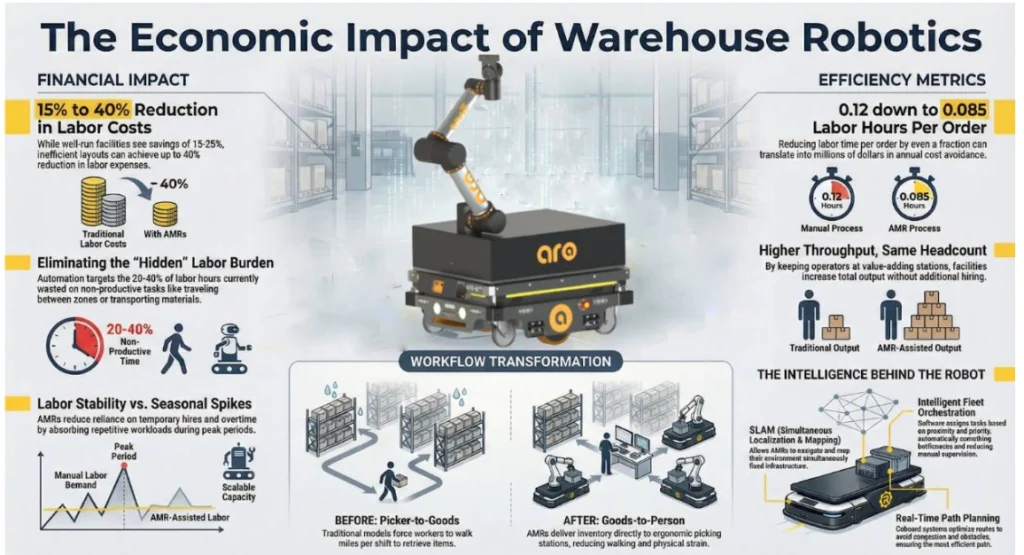
When you break down labor activity, it’s not uncommon to find that 20 to 40 percent of paid hours go toward non-value-added tasks. Transporting items from one zone to another is a prime example. It’s necessary, but it doesn’t directly improve accuracy, quality, or throughput.
I once reviewed operations at a facility where pickers walked nearly 10 kilometers per shift. They were working hard—but not efficiently. That’s the kind of hidden cost AMRs are designed to eliminate.
How Autonomous Robots Reduce Labor Costs
Eliminating Non-Value-Added Movement
The most immediate impact of AMRs is reducing unnecessary movement. Robots take over repetitive transport tasks—moving bins, totes, or pallets between zones—so employees can stay in one place and focus on productive work.
In one deployment I managed, introducing AMRs cut walking time for operators by more than half. The result wasn’t fewer employees—it was higher output from the same team. Orders moved faster, and workers ended their shifts less exhausted.
Optimizing Human Labor Through Task Reallocation
What really drives savings is not replacing workers, but reallocating them. When robots handle low-skill, repetitive movement, people can focus on tasks that require judgment—quality control, exception handling, and process improvement.
Over time, this shift creates a more skilled workforce and reduces the need for constant supervision. It also makes performance more predictable, which is invaluable when planning labor schedules.
Why Transport Tasks Are Ideal for AMR Automation
High-Frequency, Low-Decision Workflows
Transport tasks happen constantly in every warehouse, yet they require minimal decision-making. This makes them ideal for automation. Robots excel at consistency—they don’t get tired, distracted, or take inefficient routes.
Case Insight: Reducing Walking Time in Mid-Sized Warehouses
One of my earlier projects involved a mid-sized operation where workers spent nearly half their shift moving materials between storage and packing areas. After deploying AMRs on fixed routes, walking time dropped dramatically. Workers stayed at their stations, throughput increased, and we avoided hiring additional staff during peak periods.
That experience reinforced a key principle: if a task involves a lot of movement but little thinking, it’s a strong candidate for automation.
AMRs and Picking Efficiency
Transitioning from Picker-to-Goods to Goods-to-Person
Traditional picking models rely on workers traveling to inventory. AMRs flip that model by bringing inventory to the worker. This “goods-to-person” approach minimizes travel time and improves picking speed.
Reducing Fatigue and Increasing Consistency
Fatigue is one of the biggest sources of inconsistency in warehouse operations. When workers are tired, error rates go up and productivity drops. By reducing walking, AMRs help maintain steady performance across shifts.
I’ve seen teams go from highly variable output to consistent, predictable performance simply by removing the physical strain of constant movement.
Stabilizing Labor Demand with Autonomous Robots
Managing Peak Seasons Without Excess Hiring
Peak seasons are one of the biggest cost drivers in warehousing. Hiring temporary workers is expensive, and training them takes time. AMRs provide a more flexible solution by absorbing increased workload without increasing headcount.
Reducing Dependence on Temporary Labor
Temporary staff often have lower productivity and higher error rates. By using robots to handle repetitive tasks, warehouses can rely less on short-term labor and maintain higher overall quality.
In one operation, we reduced seasonal hiring by nearly 30% simply by scaling up robot utilization during peak demand.
Measuring AMR Labor Cost Savings in Warehouses
Key Metrics: Labor Hours per Order and Cost per Pick
To understand the true impact of AMRs, you need to look beyond general productivity claims. Key metrics include labor hours per order, cost per pick, and units processed per labor hour.
Translating Small Efficiency Gains into Large Savings
In one fulfillment center, we reduced labor hours per order from 0.12 to 0.085. On paper, that seems minor. But across tens of thousands of weekly orders, it translated into substantial annual savings.
This is where AMRs shine—small, consistent improvements that scale across the entire operation.
The Technology Behind AMR Labor Optimization
SLAM Navigation and Real-Time Path Planning
Modern AMRs use technologies like SLAM (Simultaneous Localization and Mapping) to navigate dynamically without fixed infrastructure. They continuously adjust routes based on obstacles and traffic.
Fleet Orchestration and Task Allocation
At the fleet level, software assigns tasks based on priority and proximity, ensuring efficient use of each robot. This reduces bottlenecks and minimizes idle time—something that’s much harder to achieve with manual coordination.
Realistic Expectations for Labor Cost Reduction
Typical Savings Ranges Across Different Warehouses
In well-optimized facilities, labor cost reductions typically range from 15 to 25 percent. In environments with heavy manual transport, savings can reach 25 to 40 percent.
When AMRs Deliver the Most Value
AMRs are most effective in operations with high volumes, repetitive workflows, and significant travel distances. In smaller or already highly optimized environments, the impact may be more limited.
Robots amplify good processes—but they won’t fix broken ones.
Deployment Strategies for Maximum ROI
Identifying High-Impact Automation Opportunities
The best starting point is identifying tasks dominated by walking, waiting, or repetitive transport. These areas usually offer the fastest return on investment.
The Importance of Pilot Programs and Gradual Scaling
Rather than deploying robots across the entire warehouse at once, successful operations start with a pilot. This allows teams to refine workflows, build confidence, and measure results before scaling.
I’ve found that gradual adoption not only reduces risk but also leads to better long-term outcomes.
Indirect Labor Savings Often Overlooked
Reduced Turnover and Faster Employee Onboarding
When work becomes less physically demanding, employees are more likely to stay. Turnover drops, and new hires can reach productivity faster because their roles are simpler and more structured.
Safety Improvements and Lower Injury Costs
Fewer injuries mean fewer disruptions, lower insurance costs, and less lost time. These savings don’t always show up immediately, but they have a significant long-term impact.
Evaluating AMR Vendors for Labor Optimization
Key Performance Indicators to Request
When evaluating vendors, focus on measurable results: labor hours before and after deployment, robot utilization rates, and performance during peak periods.
Red Flags in Automation Proposals
Be cautious of vague claims without data. If a vendor can’t provide real operational metrics, the projected savings may not be realistic.
Conclusion: Autonomous Robots as a Labor Force Multiplier
Autonomous robots are not about replacing people—they’re about making better use of human effort. In every successful deployment I’ve been part of, employees walked less and contributed more meaningfully to operations.
Robots handled the repetitive logistics, while people focused on decision-making, quality, and improvement. The result was a more efficient, more predictable, and more scalable operation.
For warehouses facing ongoing labor challenges, AMRs are no longer experimental. They are a practical solution that, when deployed thoughtfully, reduce labor costs while improving the overall working environment.