As a warehouse manager with over 20 years of experience, I’ve seen how manual labor can drain productivity. Long shifts, repetitive lifting, and human error make it tough to keep operations efficient. Everything changed when we integrated autonomous mobile robots (AMRs) into our workflow. These machines aren’t futuristic gadgets — they’re practical tools solving problems businesses face every single day. If you’re wondering why businesses need autonomous mobile robots, here’s what I’ve learned firsthand.
Boost Productivity Through Smart Automation
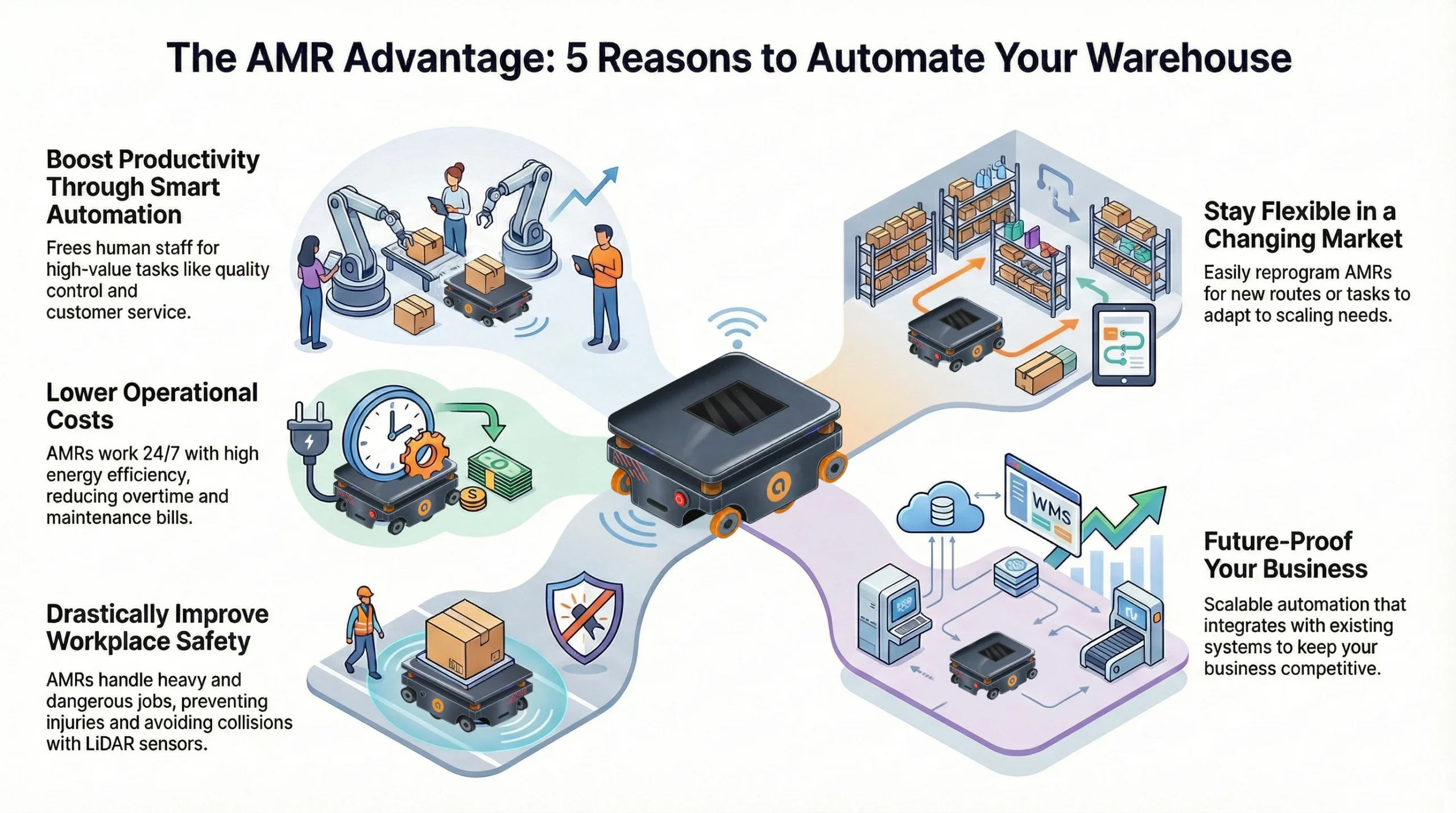
Manual tasks slow down even the best teams. Picking, sorting, and moving materials can take up most of the day — and when people get tired, errors multiply. That’s where AMRs shine. They’re built to handle repetitive work fast and without breaks. Instead of wasting time moving pallets or boxes, your crew can focus on what truly matters: quality control, customer service, and high-value tasks. In our warehouse, an AMR now moves raw materials between workstations automatically. No supervision, no delays. It’s like having a reliable team member who never calls in sick and never needs a coffee break.
Lower Operational Costs and Simplify Maintenance
At first glance, investing in autonomous mobile robots seems expensive. But when you look closer, it’s actually one of the smartest financial decisions you can make. AMRs are energy-efficient, require minimal maintenance, and work around the clock. They’re equipped with predictive diagnostic systems that spot issues before they cause downtime. That means fewer surprises, lower maintenance bills, and smoother planning. After integrating an AMR— our autonomous mobile robot capable of carrying 120 kg and running for 7 hours straight — we saw immediate savings. Instead of hiring extra workers for night shifts or overtime, the AMRs kept production flowing seamlessly.
Improve Workplace Safety Without Compromise
Safety isn’t optional — it’s the foundation of a good operation. Over the years, I’ve seen too many injuries from lifting heavy loads or rushing to meet deadlines. AMRs have drastically changed that. Equipped with LiDAR sensors and smart navigation systems, they detect obstacles, avoid collisions, and move safely even in crowded environments. They take on the heavy, repetitive, and dangerous jobs, keeping workers safe while maintaining productivity. In our warehouse, the difference was clear within weeks. Instead of workers constantly on the move with forklifts, AMRs handled transport. Fewer near misses. Fewer strains. A safer, calmer workspace.
Stay Flexible in a Changing Market
Business demands change fast. One month it’s steady, the next it’s all hands on deck. Traditional conveyor systems can’t adapt that quickly — but AMRs can. You can easily reprogram them to handle different routes, tasks, or schedules. They adapt to new workflows without needing costly infrastructure changes. That kind of flexibility gives you an edge, especially when scaling up or adjusting for seasonal demand. When we expanded into a new section of our warehouse, we didn’t need to buy new equipment or rebuild anything. We just updated our AMR’s navigation maps, and they handled the rest.
Future-Proof Your Business with Scalable Automation
Here’s the truth: automation isn’t coming — it’s already here. And the companies that adapt will stay ahead. Autonomous mobile robots aren’t a passing trend; they’re the backbone of the modern warehouse. Technology is evolving fast — better batteries, smarter sensors, improved AI navigation — and AMRs keep improving with it. Whether you run a small facility or a large distribution hub, they scale with your needs and integrate smoothly with your existing Warehouse Management System (WMS). The real question isn’t “Should we invest in automation?” It’s “Can we afford not to?”
The Bottom Line: Why Your Business Needs AMRs Now
If you’re still relying on manual labor for repetitive, time-consuming tasks, you’re already behind. Autonomous mobile robots (AMRs) help reduce costs, improve safety, and boost efficiency — all while giving your team more time for meaningful work. As someone who’s spent decades walking warehouse floors, I can tell you: adopting AMRs isn’t about replacing people. It’s about empowering them and building a smarter, safer, and more sustainable operation. Don’t wait until your competitors outpace you. Start exploring how an AMR (Aro-S) from Aro — with its 120 kg payload capacity and 7-hour battery life — can transform your operations today. The future of warehouse automation isn’t coming someday. It’s already rolling down your aisles.